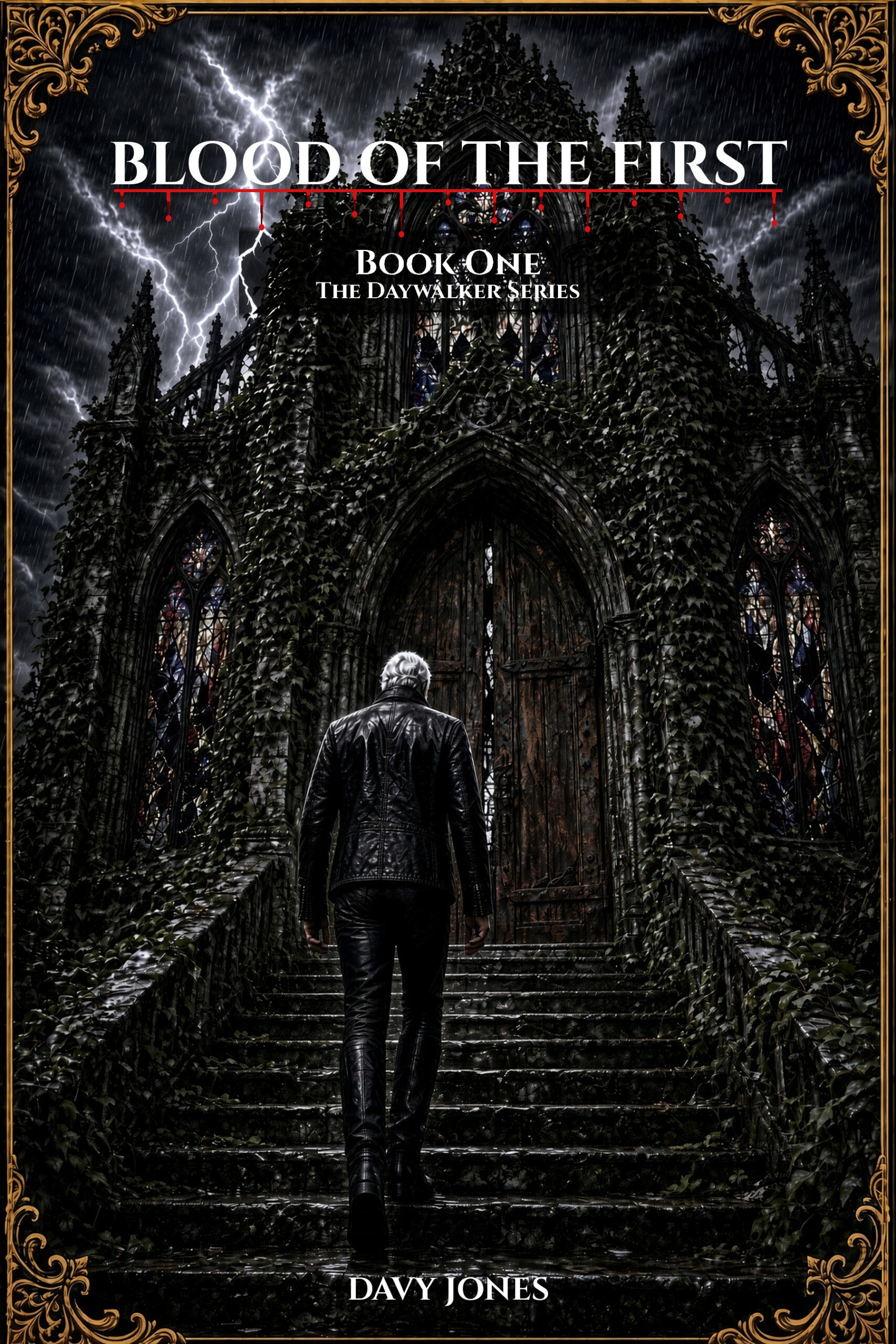
Chronicles of Gabriel Jones
Book One of The Daywalker Series. A detective walks into the dark and emerges as something the world has not seen in five thousand years.

About the Book
Blood of the First introduces Detective Gabriel Jones, a Daywalker, caught between the human world and the monstrous forces moving beneath it. The story blends supernatural noir, political conflict, rival factions, and an ancient threat rising from the shadows.
This opening novel sets the tone for The Daywalker Series with dark atmosphere, cinematic tension, and a world where every revelation comes with a cost.
- Blood of the First is now available on Amazon ! Click on the links below.
BUY HERE
Preview
PROLOGUE
The silence in an empty house doesn’t hit you all at once. It isn’t a sudden, suffocating vacuum. It creeps in around the edges, filling the negative space where a life used to happen. It settles into the corners where a voice once called from the kitchen, where a kettle used to whistle on the back burner, where two pairs of footsteps once found a familiar, unspoken rhythm on the worn hardwood floors.
Eventually the silence becomes the only thing you can hear.
After Sarah died, that silence took over. It coated the furniture like dust. It made the walls feel closer, the ceilings lower. I would sit in the dark living room for hours, listening to the house settle, waiting for a sound I knew with agonizing certainty would never come again.
For twenty-four years I had been a homicide detective. I knew what death looked like. I was intimately acquainted with its aftermath. I had stood over corpses in rain-slick alleyways while neon signs buzzed overhead. I had breathed through my mouth to avoid the cloying iron-and-ammonia stench of decay in abandoned tenements. I had knocked on front doors at three in the morning and delivered the kind of news that shattered people’s worlds into unfixable, jagged pieces.
Through all of it I thought I was immune. You build a wall when you carry a badge that long. You have to. I thought I understood exactly how grief worked—that it was a tactical problem, a case to be solved, a file to be stamped and closed, a physical wound that eventually scarred over thick and numb.
I was wrong.
When the cancer took Sarah, it left no trail of evidence I could bag and tag. It left no suspect I could hunt down, read his rights, and put in handcuffs. There was no interrogation room, no justice, no closure. It simply took her, piece by agonizing piece—first her bright laugh, then her energy, and finally her breath—until the hospice bed was empty and I was left standing alone in a house full of her things: half-read books on the nightstand, coats still hanging by the door, waiting for a winter she would never see.
Then came the department’s medical board.
They didn’t look me in the eye when they did it. They sat in a sterile room under fluorescent lights, reviewing my jacket as if twenty-four years of service were nothing more than a math equation that no longer balanced. They said my focus was shot. They said I was a liability—a veteran pushing fifty, staring off into space during morning briefings, letting minor but crucial details slide at crime scenes.
They called it an honorable service retirement. We all knew what it really was: a mercy killing for a career that had stayed past its expiration date. They put a heavy gold watch on my wrist, pushed a thick stack of pension papers across a polished mahogany desk, and had a sympathetic lieutenant walk me out the front doors.
Just like that, the badge was gone. The weight of it on my belt, the authority it carried, the clear sense of purpose—evaporated. The job that had defined every waking hour of my adult life vanished, leaving me with nothing to wake up for and far too much time to sit in that silent house and think.
Five years followed. Five long, grey, suffocating years of hollow routine.
Every morning I pulled my heavy service revolver from the bedside drawer. I dropped the cylinder, ejected the hollow-points into my palm, felt the familiar cold brass. I ran a patch through the barrel, re-oiled the steel until it smelled of solvent and memory, reloaded it, and put it right back. Then I walked down the block to the corner diner, sat in the back booth where I could watch the door, pushed a plate of cold rubbery eggs around, and listened to the rain drum against the glass.
Every night the same intrusive thought echoed in the quiet, dusty corners of my mind: You’re just waiting around to die, Gabe. Why keep waiting?
By the time the storm hit, I had finally reached the end of my rope.
I sat in the dark living room for one last hour and tried to find a reason. Not a grand one. Not a purpose-of-life, light-at-the-end-of-the-tunnel reason—I had stopped expecting those after the first year. I was looking for something small. Something concrete and specific that a tired fifty-five-year-old ex-homicide detective could hold in his hands and call sufficient.
I ran through every inventory I had left.
The house: four walls full of another person’s things and the particular silence that accumulates when a voice that once filled a space stops permanently. The pension: a number on a direct deposit that arrived every month whether I was upright to spend it or not. The city: I had given everything to its worst hours, and it had returned the favor by retiring me five months after Sarah’s funeral with a gold watch and a sympathetic lieutenant’s handshake.
The inventory came up empty.
The storm hit the windows like it meant it. The barometer plummeted. A sprawling, violent summer tempest rolled in, and the weight in my chest was suddenly something I could no longer carry through to another sunrise. The house felt like a tomb.
I went to the drawer. I loaded six rounds into the cylinder, feeling the heavy, definitive click of each one seating into place. I slipped the gun into my worn shoulder holster, letting its weight anchor me, and walked out into the pouring rain.
I didn’t have a plan, not really. I only knew I didn’t want to do it in the house. I couldn’t stomach the thought of whatever rookie caught the call having to scrub Sarah’s home, having to step over her Persian rugs in crime-scene booties.
I walked for hours, letting the freezing rain soak through to my shoulders, until I ended up at the old St. Jude’s Cathedral on the far edge of the district.
It was an abandoned, rotting ruin now. The massive stained-glass windows were shattered, leaving jagged teeth of colored glass in the lead frames. Thick parasitic ivy choked the stone arches, slowly pulling the masonry apart. The heavy oak front doors sagged precariously on their rusted iron hinges. When I was a young patrol officer running a squad car through this sector, I had driven past it a thousand times and seen it as nothing more than another piece of urban decay.
Tonight, illuminated by sudden violent flashes of summer lightning, the cathedral looked different. It looked like a place that understood exactly what it meant to be broken.
I stood in the rain at the base of the steps for a long moment.
A career of walking through doors that led to the worst things human beings did to each other had given me a specific relationship with thresholds. You always know, before you cross one, what general category of thing is waiting on the other side. You develop a sense for it—the particular quality of the silence, the smell of the air, the way the darkness is arranged. It isn’t intuition. It’s pattern recognition built from a thousand crime scenes, a thousand wrong addresses, a thousand moments of pushing a door open and letting your eyes adjust to whatever the dark has decided to keep.
The air outside was cold and dead and ancient, smelling of centuries of extinguished candles and the particular decay of a building that had stopped being maintained before I was born. My service revolver sat heavy in the shoulder holster. My footsteps on the wet flagstones were the only sound in the world.
Whatever I was looking for in here, I had stopped pretending it was a sign.
I pushed open the heavy oak door, shoulder straining against the warped wood, and stepped out of the howling wind. The air inside was deader still—wet ash, rot, and the lingering ghost of incense that had not been burned in decades. I was looking for a quiet pew, a corner of deep shadow. Maybe, in some foolish desperate corner of my heart, I was looking for a sign, some divine intervention, anything that might tell me my life still meant something.
Or, if no sign came, I was looking for a dark, quiet place to pull the trigger and finally stop the noise in my head.
I was looking for peace. I was looking for an end.
I had no idea that the real monsters were already waiting inside the dark.
CHAPTER 1
The Curse
The storm didn’t merely strike the abandoned cathedral. It assaulted it.
Rain lashed through the shattered iron frames of the stained-glass windows, drumming a frantic rhythm against the sagging slate roof—like a thousand desperate fingers trying to claw their way inside. Gale winds tore decades of neglect loose, sweeping thick layers of dust, jagged plaster, and the brittle remains of dead ivy across the rotting marble of the central altar. The air in the nave was dense and heavy. It carried the sharp ozone of recent lightning, the sulfurous bite of spent gunpowder, and beneath it all the unmistakable hot-copper tang of freshly spilled blood.
I crouched low behind a decaying oak pew, knees pressed hard into the unforgiving stone. My breathing stayed deep and measured—the steady rhythm drilled into me by decades of high-stress encounters. The leather jacket I wore was dark with rainwater and hung heavy off my shoulders, smelling of wet tannin and age. My knuckles were bone-white around the aluminum flashlight I kept switched off. Light would only make me a target.
My eyes—tired, cold, the eyes of a homicide detective—stayed locked on the center aisle.
At fifty-five, after five years of hollow retirement following Sarah’s death, I understood the geometry of violence better than most men understood their own reflections. I knew the telltale signs of human aggression: the chaotic swing of a brawler, the panicked twitch of a cornered suspect, the rigid forward lean of a calculated killer. Human violence had rules. It required windup. It required leverage and momentum.
I had never seen a killer move like this.
I had hunted the worst the city had to offer. I knew as absolute fact that the real monsters were only men—sick, broken, cruel men, but flesh and blood all the same. There were no ghosts. No demons. Only bad wiring and cold hearts. So as I watched the pale figure in the center aisle, my rational mind scrambled to force him into a category that still made sense. A hopped-up junkie. A trained psychopath on some new synthetic. Something with a chemical explanation.
I didn’t know his name. I only knew that whatever was in his system let him move with a fluid, terrifying grace that ignored every law of kinetic force I had ever learned.
Ten feet away, a heavily armored soldier in battered Kevlar traded furious, impossibly fast blows with the pale stranger. The man was dressed in simple, flowing dark garments and looked to be in his early thirties, yet his body moved like a shadow thrown by a flickering candle across the uneven flagstones.
The soldier lunged, bringing an intricately etched blade down in a two-handed arc aimed at the stranger’s collarbone. The pale man barely shifted his stance. He parried the massive blade with a lazy, almost dismissive sweep of his bare forearm. The razor edge tore through the dark sleeve but failed to draw a single drop of blood from the skin beneath.
Before the soldier could recover, the attacker reached out. Long, pale fingers locked casually around the thick nylon webbing of the tactical collar. With a sickening lack of effort—without any visible strain in neck or shoulder—the stranger lifted the two-hundred-pound soldier three feet off the floor.
“Help…” the soldier gasped, boots kicking uselessly at empty air, face darkening to a deep bruised purple as his airway crushed. “The… the weapon…”
His Kevlar-gloved fingers twitched and lost their grip. A strangely shaped firearm slipped free, clattering across the flagstones and spinning end over end across the slick floor.
I looked down at it. I had no idea of the make, the model, or the caliber resting in its oversized cylinder. The intricate etchings along the barrel meant nothing to me. I only knew one fundamental truth: when a psychopath is tearing a man apart in front of you, a gun is the tool you use to stop him.
The killer turned his head slowly, the movement jerky and unnatural, like a predator locking onto a new heartbeat. My rational mind finally began to fracture. His eyes were not human. They were pools of liquid obsidian—no white, no iris—cold and infinitely heavy with the weight of uncounted centuries.
With a sudden, sickening wet crack, he flicked his wrist.
The soldier’s neck snapped like a tree branch under winter ice. The tension left the armored body instantly. The attacker opened his pale hand and dropped him like discarded trash. The body hit the floor with a dull, final thud.
I didn’t hesitate. Decades of training overrode the paralyzing shock of the impossible. I lunged from the meager cover of the rotting pew, diving flat across the slick, blood-stained aisle toward the weapon. My fingers slammed down on the freezing textured grip. I used the momentum to roll hard onto my back, bringing the barrel up to acquire the target—
A sudden, suffocating shadow swallowed the ambient light above me.
Before my trigger finger could even begin the double-action pull, the creature struck. The movement was a terrifying blur, closing the ten-foot gap in a fraction of a second.
BOOM.
The back of my head and shoulders slammed into the jagged masonry wall behind the altar. The impact rattled the teeth in my skull, drove every drop of oxygen from my lungs in a ragged gasp, and set my vision swimming in white starbursts of pain. The attacker’s hand—cold as deep river ice, unyielding as forged iron—crushed my throat flush against the stone, pinning my six-foot frame half a foot off the ground.
Then the voice detonated directly inside my mind. It bypassed my ears entirely, a psychic intrusion so forceful it blurred my vision. My lifelong skepticism shattered.
Do you dare point iron at a god? The telepathic voice was the sound of dry autumn leaves scraping relentlessly across wet concrete. I am one of the First. I walked this earth before your grandest cities were even ashes in the dirt. I drank the blood of emperors while your primitive ancestors still huddled in caves, begging the sun not to set.
I clawed at the iron grip crushing my windpipe. My hands couldn’t budge the arm a single millimeter.
Look at you, the ancient voice mocked, vibrating with insurmountable arrogance. A broken, aging mortal. A pathetic lawman clinging to a badge that means nothing in the dark. Your laws, your justice, your metal toys—they are the delusions of mayflies. You have no chance against the eternal. You are nothing but food.
The creature’s jaw unhinged with a horrifying click of bone and cartilage. Fangs slid smoothly from his upper gums—long, painfully sharp, translucent ivory, gleaming wetly in the faint moonlight that filtered through the storm.
With the speed of a striking viper he drove them deep into the left side of my neck.
I let out a strangled, breathless cry against the crushing grip. The agony was not merely physical. It felt as though boiling lead had been injected straight into my nervous system. The venom burned like a live electrical wire tracing the path of my veins. My vision darkened at the edges. Massive crimson blooms expanded across my field of view as my blood pressure plummeted.
My body was shutting down under the overwhelming shock of the predator’s bite. But my right hand—trapped tightly between my own torso and the monster’s rock-hard chest—remained locked around the frame of the firearm.
Driven by pure primitive survival instinct, I forced my failing arm to move. I pressed the steel muzzle firmly against the center of the attacker’s ribs, angling it upward toward where a human heart would be, and squeezed the trigger.
BANG.
The deafening report of the hand-cannon shattered the silence of the cathedral, ringing off the stone walls and echoing up into the rafters. The muzzle flash illuminated every carved saint and fractured archway in a blinding split-second of violent orange light.
The heavy projectile shattered the creature’s ribs at point-blank range and tore deep into the center of his chest. Whatever ammunition that strange weapon carried, it was devastating.
The stranger froze. The paralyzing bite vanished from my neck as his head snapped back in shock. A high-pitched, unnatural shriek—a sound of ancient agony—escaped his throat, vibrating the remaining shards of glass in the high window frames. Beneath his pale skin, aggressive veins of brilliant incandescent silver light ignited at the entry wound. The unknown metal reacted violently with his dark biology, the glowing lines spreading outward under his flesh like liquid fire consuming dry parchment.
He stumbled backward. His iron grip broke. The telepathic presence in my mind shattered into fragments of terrified static. I collapsed heavily onto the hard floor, hands flying to my torn throat, gasping for air that felt like broken glass entering my lungs.
The attacker fell to his knees in the center aisle. He clutched his torso, screaming as his vocal cords tore and his flesh began to blacken, blister, and rot away from the bone. Plumes of acrid grey smoke poured from the bullet wound.
“You humans have spent millennia hunting us!” the creature roared, his physical voice cracking and warping into a dry metallic scream as the strange poison ate him alive from the core. “Now… the one who slays me will spend eternity as one of us!”
With a final spiteful surge of dying strength he raised his left forearm, plunged his own fangs deep into his wrist, and ripped the flesh open. Black, impossibly thick, luminous blood welled from the jagged tear.
Before I could drag myself away he lunged, grabbed me by the hair, and yanked my head back against the stone floor. He pressed the open, bleeding wound directly over my mouth.
“Drink!” he rasped. His face was already crumbling into grey flaky powder even as he held me pinned. “Suffer the burden of the First!”
I fought it.
Not because I wanted to survive—I had walked in here specifically because I didn’t. I fought because the body doesn’t care what the mind has decided. Fifty-five years of accumulated biology do not consult the brain’s conclusions. The jaw clenches. The spine arches. The hands push. The throat tightens. Every system fires in the direction of continuation without a single vote from the man operating them……………………………………
Continue the Journey
Join the mailing list for release news, updates from Davy Jones, and future entries in The Daywalker Series.